.png)
Introduction
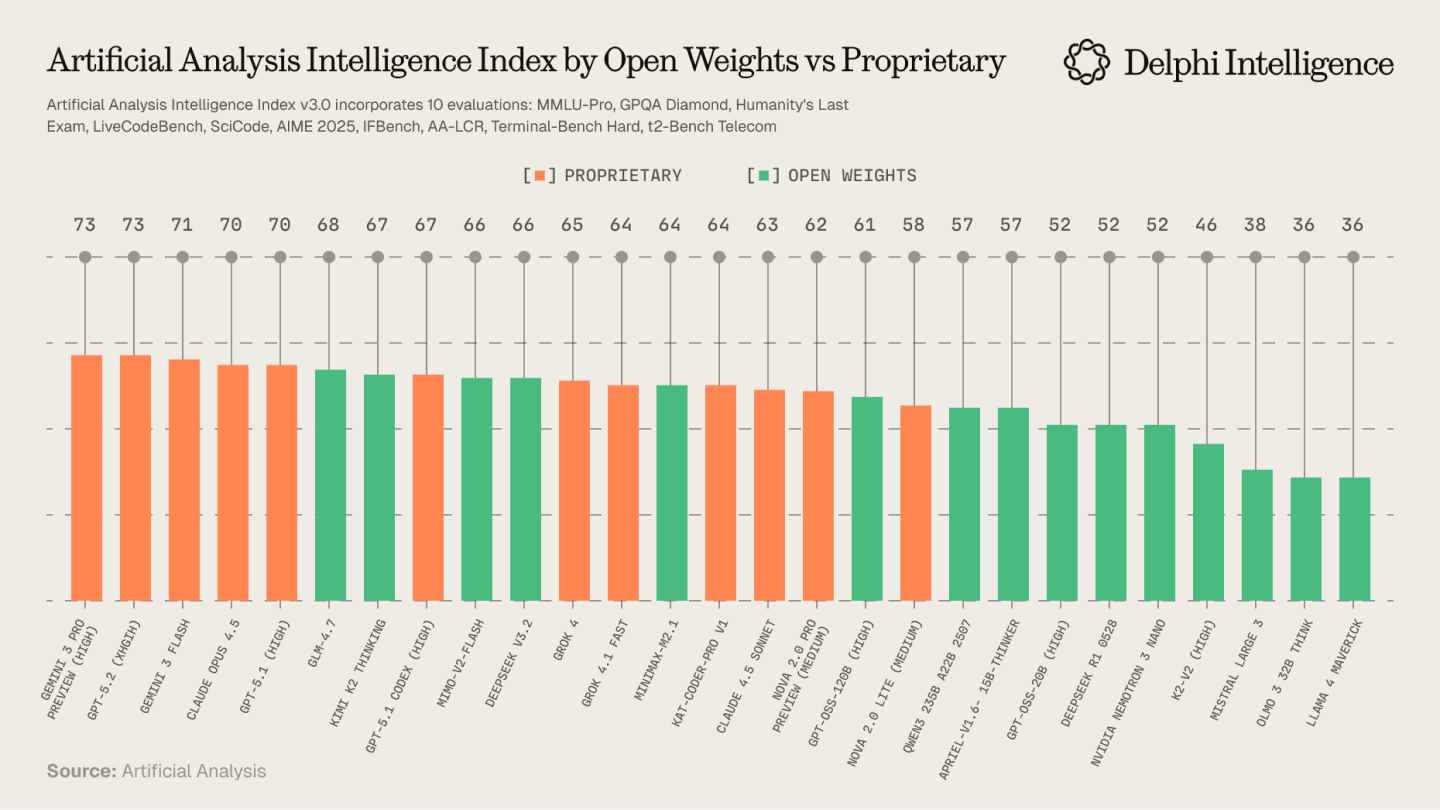
2025 was the year of open source. It was also the year of China. It was the year America realized that it was not alone in the AI race.
If 2023-2024 were a New Hope, with OpenAI and Co. unleashing the wonders of generative AI upon the world, then 2025 was the year the Middle Kingdom struck back: releasing open source models on a bi-monthly cadence, ceaselessly nimbling away at the gaps on core benchmarks.
"You can see the future first in San Francisco."
That was the first line from Leopold Aschenbrenner's viral manifesto in June of 2024. It is generally true. However, living in Shanghai during 2025 was the first time it felt like I was living six months ahead of the U.S. news cycle, at least with regards to conversations about tech and AI and China. Many conversations pre and post "the DeepSeek Moment" had made it quite clear that China would be a formidable competitor across much of the technological frontier. This realization gradually ramped up in Silicon Valley throughout the year, the exclamation coming in the form of Dan Wang's Breakneck, which became perhaps the most read book in San Francisco in 2025.
The US and China are making fundamentally different bets on AI, the US is betting on superintelligence. China is betting on commoditized intelligence. The U.S. closed labs are seeking to build God and reap monopoly profits. The Chinese aim to build an enabler which can be infused into their massive industrial base, make up for deficiencies in services, and ensure domestic stability / control.
In 2026, my most basic predictions are two-fold: 1) The absolutely massive data center investments the U.S. hyperscalers will demonstrate clear performance pay offs in 2026, with SOTA model capabilities reaccelerating the gap with Chinese open source from ~6months to ~18 months by December 2026. 2) China and open source will remain hardware constrained, falling markedly behind in SOTA level reasoning (math / science) ~18 months, but closer in performance on specific tasks like coding, long-context (RAG), and agentic workflows (~6 months). At the same time, China's deep tech breakthroughs and the compounding atop its electro-industrial stack will only accelerate - riding decades of investment in education, infrastructure, dense supplier networks, and abundant policy support. The EV and biotech booms are just the start of a wide array of industries in which China will challenge the frontier, because - in many ways - they require many similar inputs.
The stage is set. 2026 appears poised to bring us "The Return of the U.S. Labs": scaling law excitement reignited after a (relatively) lackluster 2025 as the next magnitude clusters come online. However, the entire U.S. economy is now a levered bet on scaling compute. The largest, most profitable companies in history, accounting for ~35% of the US stock market have "bet the farm." 2026 will be the year where these colossal investments are put to the test.
The bull market in equities, a possible recession, and a potential material recalibration of the relative might of both the US and Chinese political economic models hangs in the balance.
The USA's biggest advantages are its deep capital markets and its ability to attract the best talent the world over. The latter is coming under strain. The former has been on full display but is now highly levered to a single theme.
2026 will likely be the year which reveals which system has been making the right bets.
26 Predictions for 2026
AI and Society
1. The "Arranged Marriage" Returns
- Dating app fatigue hits a breaking point; a new dating app goes viral replacing swipes with agent to agent interactions and much more tailored matching for real relationships
- Your AI agent negotiates with 1,000 other agents to check compatibility, verify identity, and schedule the calendar invite before you ever see a photo, based on a much greater degree of content / context
2. Anti Automation Politics: The Mamdani Shift
- Despite public revelations of massive fraud in blue states like Minnesota, Illinois, and California, left leaning populists gain ground - Silicon Valley has done a terrible job of marketing AI to a service economy spooked by automation and jobloss. They pay a political price in 2026
- The democrats win the house, make a credible run at the Senate (though fall short), and flip a few notable gubernatorial races. The fears of job loss, cost of power, cost of housing, and inequality are ripe for a AI themed political tech lash
3. Ambient Computing: Glasses beat the Pin
- Smart glasses (Meta Orion/Ray-Ban) firmly defeat "AI Pins" as the dominant form factor for ambient AI.
- Greenshoots of the "Post-Smartphone" era emerge: early adopters (5% of the US population are ok without their phones for extended periods)
4. The First "Mars Fleet" Departs
- SpaceX launches a flotilla of ~5 uncrewed Starships to Mars in the late 2026 .
- The trip proves orbital refilling is viable and delivers hardware to preseed a "crewed trip" within the next five years
AI Infrastructure Supercycle
5. Energy Becomes the Benchmark: Tokens/Joule
- "Tokens per Dollar" is replaced by "Tokens per Joule" as the crucial marketing metric. As data center power constraints hit a wall, models are judged on their energy efficiency.
- Emerging, highly power-efficient approaches to compute like Thermodynamic computing, Spiking Neural Networks, and similar approaches become one of the larger venture buckets of 2026
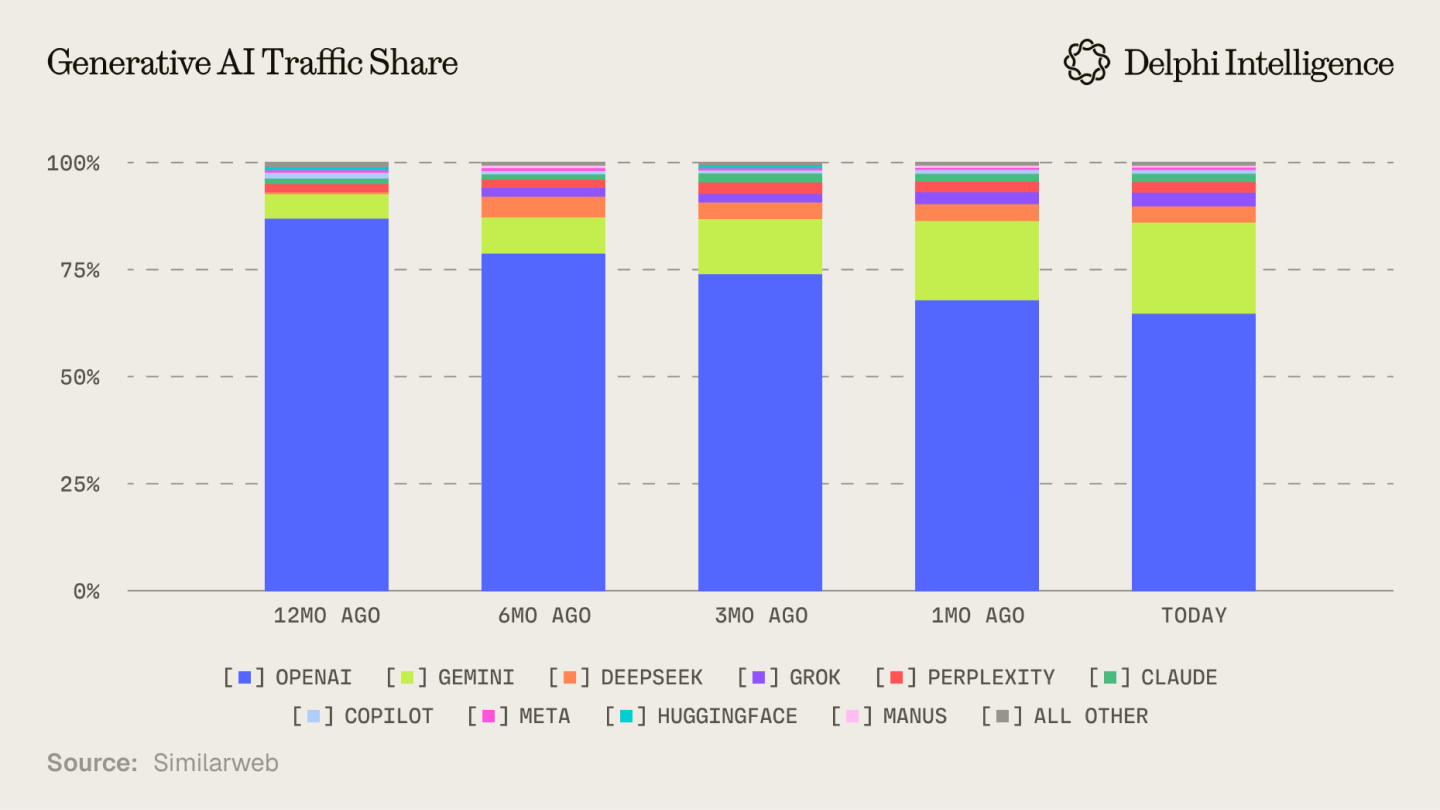
6. Google Becomes #1 by Traffic
- The Google juggernaut was resurrected in 2025, and despite large Blackwell clusters coming online and giving a performance boost to its rivals, the chase down of OpenAI continues in 2026
- This is one of the more aggressive predictions, and very smart people at Coatue and others would disagree, but the direction of travel seems clear - across infrastructure, investment, research, data and distribution - Google continues to hum and gain considerable share
7. Photonics Goes Mainstream: The "Optical Interconnect" Flip
- Co-packaged optics (CPO) moves from "frontier demo" to default on AI network roadmaps. Copper interconnects hit a physics wall for the largest clusters.
- The optical interconnect M&A activity continues apace with at least 1, likely 2 more multi-billion dollar acquisitions announced.
8. Edge Inference & The RAM Squeeze
- Small Language Models (SLMs) running locally on laptops become the default for privacy-sensitive tasks, driving an inflection in high-RAM consumer devices
- Apple and Microsoft market "Local Intelligence" as the premium tier, convincing enterprises that cloud inference is a security risk
9. Distributed Compute Protocols find (modest) Product-Market Fit
- Distributed compute networks led by Nous Research, Prime Intellect, Gensyn and others move from speculation to revenue inflection
The Agentic Economy: Software Transitions from Tool to Labor
10. A substantial number of software providers switch to outcome based pricing
- We see major enterprise software contracts priced in "outcomes delivered" rather than "per seat."
- SaaS gross margins dive as incumbents embrace the shift to the agentic era. Markets puke initially but then reward first movers with higher multiples (similar to on-prem to cloud transition)
11. Search Traffic Drops 15% as "Answer Engines" Win
- For the first time, traditional blue-link search volume declines markedly as users shift queries to answer engines
12. AI Copyright: The "Spotify for Data" Settlement
- A landmark settlement (likely involving OpenAI/Microsoft and major publishers) establishes a standardized licensing model for training data and makes it legally risky to scrape, forcing labs to begin paying.
- "Data Rights" become a more formal and liquid asset class, with media companies valued based on their clean, structured archives.
China & AI Geopolitics
13. Chinese equities outperform
- Institutional capital begins rotating back into China, realizing that there are two markets with frontier innovation and one is still priced at a material discount and likely to continue seeing strong policy support in a deflationary environment. (Hang Seng Tech Index > Nasdaq)
- At the same time, more of China's top talent exits China to start small, yet high impact teams in less controversial jurisdictions in search of global customers, compute, and capital. Singapore is the largest beneficiary.
14. ByteDance Priced as a Global Hyperscaler
- Bytedance's valuation continues to rise considerably in secondary markets - shifting from its pricing as a social app to a proper AI hyperscaler
- Mix of revenues, talent, and infra investment (US$23b) see Bytedance priced as China's number 1 AI champion
15. The "Low-Altitude Economy" Goes Legal
- China’s Civil Aviation Law creates the first legal framework for drones/eVTOLs, forcing a global sector rerate.
- Shenzhen logs millions of autonomous delivery miles and launches commercial air taxi rides
16. Rare-Earth Magnets as a "Hidden Tax"
- China tightens export controls on processed neodymium, acting as a geopolitical tax on Western robotics and EV scaling.
- Horizontal enablers within the “modular middle” (s/o to Ryan Mcentush on the great essay) of the hopefully-to-begin-to-be-reconstructed US-led consumer-electronics supply chain become a top US venture $ destination in 2026
Robotics & Hard Tech
17. Humanoids: The "Boring" 1,000-Unit PO
- Humanoid robots get their first boring, real ROI proof point: a purchase order for >1,000 units from a logistics giant like Walmart or DHL.
- Performance is spotty but operating costs drop below $10/hour, undercutting US warehouse wages to a point where serious experimentation is merited.
18. Solid-State Batteries (SSB) Hit Production
- Dongfeng Motor (and peers) begin mass production of 350 Wh/kg solid-state cells, offering 1,000km range and eliminating fire risk.
- This marks a new premium tier for EVs and makes many more eVTOL / drone routes economically viable
19. Orbital Manufacturing Returns a Product
- Varda Space Industries successfully returns a pharmaceutical processed in orbit that is commercially superior to Earth-made versions.
- Validates the business case for "factory-to-pharma" loops in space.
Bio + Health
20. Sleep Tech Moves from "Tracking" to "Modulation"
- The era of "passive tracking" (Oura/Whoop) ends; the era of active Neurostimulation begins: devices that induce sleep via transcranial Alternating Current Stimulation (tACS) become a new status symbol.
- By late 2026, a major tech giant (Apple or Meta) acquires a neuro-modulation patent portfolio, signaling that wearables are now for "writing" to the brain, not just "reading" it.
21. Generative Biology’s "De Novo" Moment
- A drug candidate designed entirely by AI (no starting molecule from nature) enters Phase 2 trials or triggers a $2B+ partnership.
22. Biotech is back
- Biotech rerates as an AI beneficiary - XBI up 15%+ on the year
- Gene editing moves from "rare disease" to "cardiovascular prevention," expanding the TAM by 100x.
23. Peptides Become a Massive Consumer Product
- The "Ozempic effect" has shifted the Overton window - experimentation with Peptides becomes a mainstream phenomenon
- Consumer wearables tracking "biological age" become mainstream
24. Bryan Johnson posts about the longevity of nightly erections >10 times in 2026.
- Self-explanatory
25. AI is a crucial participant in a "Nobel-Worthy" discovery
- AI is explicitly credited for a "new science" result in a top journal (Nature/Science) that humans could not have derived.
- Material Science is the most likely candidate - a new superconductor, battery material, or protein structure
Cyber Money
26. Bitcoin has a long overdue Gold catchup
- On the back of monetary fragmentation, liquidity injection, and mounting fears over both inflation and asset seizures, Bitcoin ignores the quantum overhang and ends the year >US$150k, shirking the traditional 4 year cycle